UNLEAVENED BREAD VERSUS CATHOLIC BREAD
JESUS AND THE FEAST OF THE UNLEAVENED BREAD
(INSTITUTING THE LORD’S SUPPER)
-COMPILED BY PETER POLLEY NGOAH-
INTRODUCTION
Do we not always preach that denominational churches are not Christians because they are not found in the bible and their practices are not approved by God ? (Hebrews 12:23, ESV: and to the assembly of the firstborn who are enrolled in heaven, and to God, the judge of all, and to the spirits of the righteous made perfect). History tells us that they are man-made churches and not registered in heaven as the church of Christ. The question here is what kind of bread was used at the beginning of the church; I mean the first Christians during the first to fourth century? The Bible confirms it was unleavened bread, bread without yeast. The roman catholic bake their bread for their communion, do we agree to use what they use? Do we believe there might be of different ingredients as the feast of the unleavened bread? I don’t believe the Jews which God instructed them to use the unleavened bread for the Passover feast will allow any other nation to bake the bread for them. Read more even on how they treated the Samaritans. For a clear conscience of our worship, since it is easy to make unleavened bread which is the bread without yeast, this study will help us gain much knowledge about catholic bread and unleavened bread and why we should try to bake our own unleavened bread for our worship.
Again, do we trust the so-called holy water of the catholic church of which the bible says call no one your Father on earth (Matthew 23: 9 -10) yet they do and those fathers claim to bless water as holy water which is used in the eucharistic and sacramental bread. Research tells us that, in the process of making the eucharist bread, sometimes holy water will be either sprinkled into the dough or on the kneading trough at the beginning of the process. Therefore, for a clear conscience why don’t we bake our own unleavened bread for our worship?
The unleavened bread is from the Passover feast and therefore we must first acquire a brief knowledge about it. The story of the Passover feast begins…
As one of the three major Jewish feasts, the Passover came completely from God with strict regulations regarding the proper rituals to be observed, specifically that the Passover lamb was to be killed at twilight on the fourteenth day of the first Jewish month. Furthermore, its blood was to be sprinkled upon the lintels of the houses in which the Israelites ate the meal, and the flesh of the lamb was to be roasted—not eaten boiled or raw. (Exodus 12:1-28)
As we move approximately 1,500 years from the initial institution of the feast, we find the Jews of Jesus’ day bound to the same regulations and specificities as those ancient compatriots of Moses. In fact, we find Jesus—as a faithful Jew “born under the law” (Galatians 4:4), and abiding without sin under that same law (1 Peter 2:22)—adhering to the proper commands of the Law of Moses. On occasion, upon healing leprous people, Jesus instructed those individuals to present themselves to the priest as the Law of Moses commanded (Matthew 8:4; Luke 17:12-14). The Pharisees’ accusations of Jesus’ breaking the Sabbath notwithstanding, Jesus lived perfectly under the Law of Moses. Since He obeyed the Law consistently, when Jesus ate the Passover feast and celebrated the ensuing Feast of Unleavened bread, it is a fact that He would not have used any leaven from the 14th day of Nisan [originally, the first Jewish month was called Abib (see Deuteronomy 16:1-10), but its name eventually was changed to Nisan (Esther 3:7)] to the 21st day of that same month, as commanded in Exodus 12:15,18-20.
ELEVEN BIBLICAL FACTS ABOUT THE BREAD AND WINE
- For Bible Christians, every word of God is pure, and following Jesus Christ according to the Bible is very important (Ps 119:128; Pr 30:5; Matt 28:20; Luke 4:4; I Cor 11:1; II Tim 3:16-17). Since we cannot know about the Lord’s Supper without the Bible, there is every reason to follow the Bible as closely as possible. Adding our own ideas would simply corrupt the Lord’s Supper (Deut 5:32; 12:32; I Chr 15:13).
- The only bread present at the Last Supper of our Lord Jesus Christ had to be unleavened bread because our Lord used the bread of the Passover Supper, which had to be unleavened bread, which is why the Passover Feast was also called the Feast of Unleavened Bread (Luke 22:7-20; Exodus 12:1-20). Our Lord Jesus Christ certainly used unleavened bread for instituting the Lord’s Supper.
- Paul taught that the Lord’s Supper fulfilled the Passover. Every church must make sure they are free from the leaven of malice and wickedness, for leaven symbolizes sin in the New Testament (Matt 16:6-12; Gal 5:9). If it is important to be free from the leaven of sin so that a church partakes as an unleavened body, it follows that the symbolic bread should also be unleavened (I Cor 5:6-8).
- The bread used in the Lord’s Supper represents the body of the Lord Jesus Christ, which was spiritually perfect as a sinless substitute, as the Passover lamb was perfect. If leaven is a symbol of sin, proven by Paul’s reference to it as such in the context of the Lord’s Supper, then we should use unleavened bread to have a proper symbol for representing our Lord’s body (I Cor 5:6-8; I Pet 1:19).
- Paul also taught that the bread of the Lord’s Supper should be one loaf that is broken during the Supper. The bread symbolizes the body of Jesus Christ that was torn for us, but it also symbolizes the unity of the congregation in one bread (I Cor 10:16-17). He called the bread a single lump (I Cor 5:7). Manufactured wafers or crackers like Catholics use precludes us from breaking the bread and showing the two pictures that the Lord and His apostles intended for us to see.
- The cup at the Last Supper contained the fruit of the vine (Luke 22:18). The beverage of choice from the vine of Israel and of all men was and is wine (Ps 104:14-15). Abraham and Melchizedek, priests of the highest God, had bread and wine for their meal (Gen 14:18). David sent a flagon of wine to every home in his celebration of moving the Ark of God (II Sam 6:19). The beverage of choice of Jesus Christ was wine, which is why His enemies called Him a winebibber (Luke 7:34). His enemies would not have called Him a winebibber, if He had drunk only grape juice. John the Baptist did not drink wine, because he was likely a lifelong Nazarite (Luke 1:15), so his enemies raised other slanderous charges against him. There is no evidence Jesus Christ ever drank grape juice.
- The beverage used at the Lord’s Supper in Corinth was wine because those who drank too much were drunken (I Cor 11:21). The word “drunken” there is a participial adjective meaning to be intoxicated by an alcoholic beverage. The Corinthians, a church instructed by Paul, used wine in the Lord’s Supper. Paul did not correct their use of wine, though he corrected and instructed them about the Supper. He corrected the abuse of eating and drinking without regard for others, but not the beverage. Drunkenness is condemned by the New Testament, but not the moderate and proper use of wine (Eph 5:18).
- It is a fact that wine is an unleavened beverage, fitting as a symbol for the sinless blood of the Son of God. The process of fermentation is initiated and maintained by the combination of sugar in the juice of the grape and the yeast or leaven that is on the skin of the grape. When grapes are crushed or pressed with their skins, fermentation begins immediately. The fermentation process ends when the alcohol content reaches about 12-14% and kills the yeast or leaven. Grape wine generally does not exceed 14% in alcohol, because the yeast does not survive that level of alcohol. The point here is that wine is an unleavened beverage to match the unleavened bread already proven.
- The social custom of the Jews at the time of Jesus Christ was to drink wine with Passover. We do not use such evidence outside the Bible to prove anything in the Bible, because we believe the testimony of Scripture is sufficient (II Tim 3:16-17). However, for those who need or want this information for their own weak faith or the persuasion of others, we make the point here. Most any conservative Bible commentary will indicate clearly in the Last Supper passages that the beverage used for the Passover was wine.
- Furthermore, the wine for the Lord’s Supper must be red wine from grapes. If it were any other kind of wine, such as blackberry or raspberry wine, then it would not be the fruit of the vine (Luke 22:18). If it were white or pink wine, then it would not clearly symbolize our Lord’s blood nor match the wine used in Israel (Gen 49:11; Deut 32:14; Ps 75:8; Pr 23:31; Is 27:2; 63:2; Rev 14:19-20; 19:13-15). There is no evidence of white wine in the Bible. The wine was assumed to be read in all figures of speech that involved grapes, wine, or winepresses.
- For the reasons given above, we use red wine and one loaf of unleavened bread in the Lord’s Supper. While we believe these two elements are important to follow the Lord Jesus Christ and the apostle Paul as closely as possible, we believe it is much more important for us to examine ourselves and partake of this Supper without the leaven of malice and wickedness in either our individual hearts or in the church collectively.
KEY VERSES
- Exodus 12: 1 – 28
- Mathew 26: 14 – 26
- Mark 14: 12 – 16
- Luke 22: 7 – 23 (Highlight verse 19)
- 1 Corinthians 11: 23 – 34
THE UNLEAVENED BREAD
Ingredients:
- 1 cup flour (Use All-Purpose flour only – Do not use self-rising flour or other bread flour)
- 1/3 cup olive oil
- 1/4 tsp salt
- 1/3 cup water
Instructions:
- Preheat the oven to 425 degrees
- Line pan with parchment paper
- Mix flour, oil, and salt together
- Add water and mix with a pastry cutter until the dough is soft
- Form dough into 6 balls and press into disks or rectangles onto a prepared baking sheet with hands
- Bake in preheated oven until cooked or barely brown 8 to 10 minutes
Baking Tips:
- Use scant 1/3 cup oil and 1/3 cup water
- Roll or pat very thin (a little thinner than pie crust)
- Always score before baking (pizza cutters are easy tools for scoring)
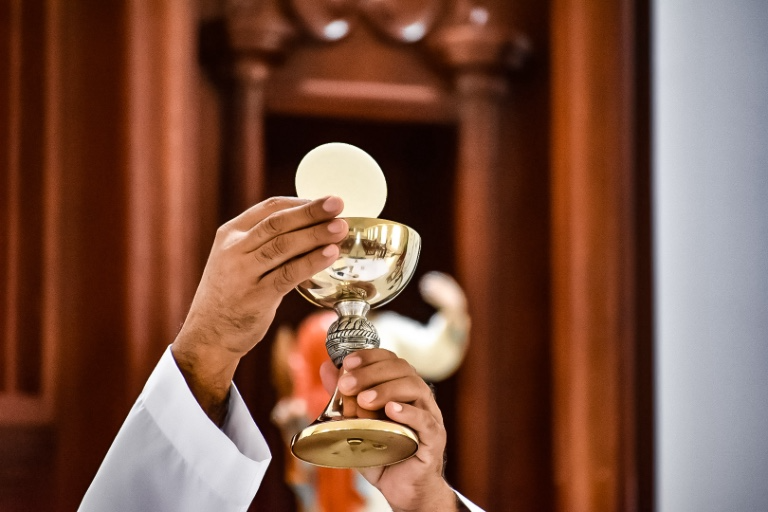
Roman Catholic Communion Bread Recipe
There are two breads of the Catholics used for communion. They are :
- Eucharistic Bread
Ingredients:
- 4 cups whole-wheat flour (unsifted)
- 2 cups white flour (unsifted)
- 2 ½ to 2 ¾ cups of warm water
- ¼ cup flour for flouring kneading surface and/or hands Mix together the 6 cups of flour.
- The Hostia or Sacramental Bread
known as prosphorá or a πρόσφορον ( prósphoron, “offering”)
Ingredients:
- fine (white) wheat flour
- pure water
- Yeast
- Salt
NOTE: Sometimes holy water will be either sprinkled into the dough or on the kneading trough at the beginning of the process.
The Eastern Christian Formation students from the Cathedral of St. John the Baptist, St. Mary Parish, and Holy Spirit Parish had a hands-on experience of making prosphora, the bread used for Communion, and an up-close presentation of the rite of preparation.
The recipe for the baking of Eucharistic bread is as per the requirements of the Roman Catholic Church’s Canon law, and the General Instruction of the Roman Missal. The recipe for Eucharistic bread is simple. It must be made from whole wheat and white flour, and water.
THE HISTORY BEHIND THE CATHOLIC COMMUNION
The Beginning of The Celebration of The Eucharist (A.D. 787)
The word “Eucharist” is a Greek word meaning “thanksgiving”. Since we read in connection with the Lord’s Supper- “ and when He had given thanks, “ this term came to be applied to the Lord’s supper. In the observance of this institution, a custom developed among those who believed they should not drink wine, of dipping the loaf into the fruit of the vine.
Tertullian believed that the bread and wine were only symbols, but that the Lord’s supper could also be applied to the dead. This idea, however, was not clearly stated, and we do not know to what extent or in what way this was practiced. Cyril of Jerusalem (315 – 386 ) was the first to clearly advocate that the Eucharist had the power to help the dead.
As time progressed and as thousands of pagans were converted to the Christian religion, the simple, weekly memorial service became infected with heathen pomp and ceremony.
Christian leaders began to imagine that the bread and wine had magical or mystic qualities. Some declared that the memorial was a sacrifice and others imagine that the partaking of the elements just prior to death would cleanse one from past sins. However, it was not until 394 A.D that the liturgy included the daily mass; during which the Eucharist is observed, and by the time of Gregory the Great (540 – 604) the sacrifice of the mass was fully established.
Gelasius, a bishop of Rome in 492 A.D condemned this practice as heresy. On the subject, he said, “Certainly the sacrament of the body and blood of our Lord, which we receive, is a divine thing; because by these we are made partakers of the divine nature. Nevertheless, the substance or nature of the bread and wine cease not to exist and assuredly the image and similitude of the body and blood of Christ are celebrated in the action of the mysteries.”
Not until a much later date did the doctrine of Transubstantiation develop. This doctrine affirmed that the loaf and the cup when blessed became the actual body and blood of Christ. The decree of the council of Trent confirming this doctrine of Transubstantiation was framed into these words. “By the consecration of the bread and wine, the whole substance of the bread is converted into the substance of the body of Christ and the whole substance of the wine is converted into the substance of his blood. Which conversion is suitably and properly called by the Catholic Church, Transubstantiation? Therefore, the bread must be made thin and flat so that they do not bite the body of Christ but melt in their mouth.
Special Attention.
The grape wine we use has many factories, not for Catholics, and beside the ingredients are labeled on it approved by the FDA. But for the eucharistic bread, the ingredients are not labeled beside anyone cannot attest to the fact that the bread is made up with this or that unless those of us who are curious search from sources on the internet. We worship God in reference and we must always have a clear conscience on whatever we do. Thank you very much for reading.